(A PDF version of this article can be downloaded
here)
When it comes to touchscreen technology, the four most prevalent types are Capacitive, Infrared, Resistive, SAW (surface acoustic wave) and Guided Wave with Resistive and Capacitive being the most widely used types for Industrial Applications. All of these technologies have their own distinct characteristics, both advantageous and with limitations. Our industrial LCD flat panel displays offer the following optional touchscreens to suit your specific application.
Capacitive
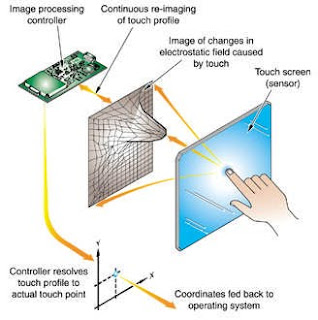
Capacitive touchscreen technology is recommended for use in KIOSK applications that require a
“finger touch”. It will not operate with either a gloved hand or with a mechanical stylus. It is made of glass, which makes it extremely durable and scratch resistant.
This glass overlay has a coating that stores the charge deposited over its surface electrically. Capacitive touchscreens operate using oscillator circuits that are located in each corner of the glass overlay and measure the capacitance or the area to be “touched”.
Depending on where the person touches the overlay, the oscillators will vary in frequency. Then a touchscreen controller measures the frequency variations to ascertain the coordinates of the person’s touch.
When used with flat panel displays, capacitive offers drift-free stable performance that is not susceptible to deterioration over time. A capacitive touchscreen is impervious to grease, dirt and water, which makes it ideal for frequent use.
Resistive

Resistive touchscreen technology is recommended for use in POS (Point of Sale): Grocery Stores, Hotels, Restaurants and Retail Stores; Industrial Applications: MMI (Man Machine Interface), Machine and Process Control; Portable Devices; Personal Information Management Systems; Transportation Solutions; Medical Solutions: Equipment, Instrumentation and Patient Monitoring Systems.
It generally uses a display overlay composed of layers, each with a conductive coating on the interior surface. Special separator “dots” are distributed evenly across the active area and separate the conductive interior layers.
The pressure from using either a mechanical stylus or finger produces an internal electrical contact at the “action point” which supplies the controller with vertical and horizontal analogue voltages for data input.
To reduce parallax for older “curved” CRT applications only, resistive touchscreens are generally spherical to match the curvature of the CRT (true flat resistive touch overlays are available for TFT flat panels and/or CRTs). Our resistive touchscreens are anti-glare to reduce reflective shine intensity, which will slightly diffuse the light output throughout the screen.
Resistive technology offers tremendous versatility in that activation can be initiated by; a gloved hand, fingernail, mechanical stylus or an ungloved finger.
Resistive touchscreens can be gasket sealed for NEMA 4 and NEMA 4X environments. Limitations include: Low light output, diffused resolution images and a plastic surface which can be scratched if improperly touched.
SAW (Surface Acoustic Wave)

SAW touchscreen technology is suggested for use in ATMs, Amusement Parks, Banking and Financial Applications, Gaming Environments, Industrial Control Rooms, and KIOSK.
SAW touch cannot be used within NEMA environments, as the technology cannot be gasket sealed. It has excellent durability that allows it to continue working if scratched since the overlay for the touch sensor is a solid glass display.
The disadvantage to this glass overlay is that it is breakable and wont work in wash down conditions. The waves are spread across the screen by bouncing off reflector arrays along the edges of the overlay. The waves are detected by two “receivers”. The acoustic wave weakens when the user touches the glass with their finger, gloved hand or soft stylus.
The coordinates are then determined by the controller circuitry that measures the time at which the amplitude declines. It is the only technology that can produce a Z-coordinate axis response. SAW technology offers drift free stable performance that is always precise. SAW offers superior image clarity, resolution, and high light transmission.
Infrared

Infrared touchscreen technology is based on “legacy” technology and is becoming increasingly replaced by Resistive or Capacitive touch systems. Over the years, Infra-red bezels have been proved to be a very reliable technology for use in ATMs, Food Service and Preparation, KIOSK, Medical Instrumentation, Process Control Systems, and Transportation Tracking applications.
It does not incorporate any sort of “overlay” that could inhibit screen clarity or brightness, but instead, uses a special bezel of LEDs (light emitting diodes) along with diametrically opposing phototransistor detectors which surround the glass of the display surface.
The controller circuitry scans the screen with an invisible lattice of intra-red light beams just in front of the surface that directs a sequence of pulses to the LED’s.
It then detects information at the location where the LEDs have become interrupted by a stylus or finger. The infrared frame housing the transmitters can impose design constraints on operator interface products.
If you are unsure what Touchscreen technology you require for your project, please feel free to contat our Technical Sales team at +44(0)1782 337 800.
(A PDF version of this article can be downloaded
here)




